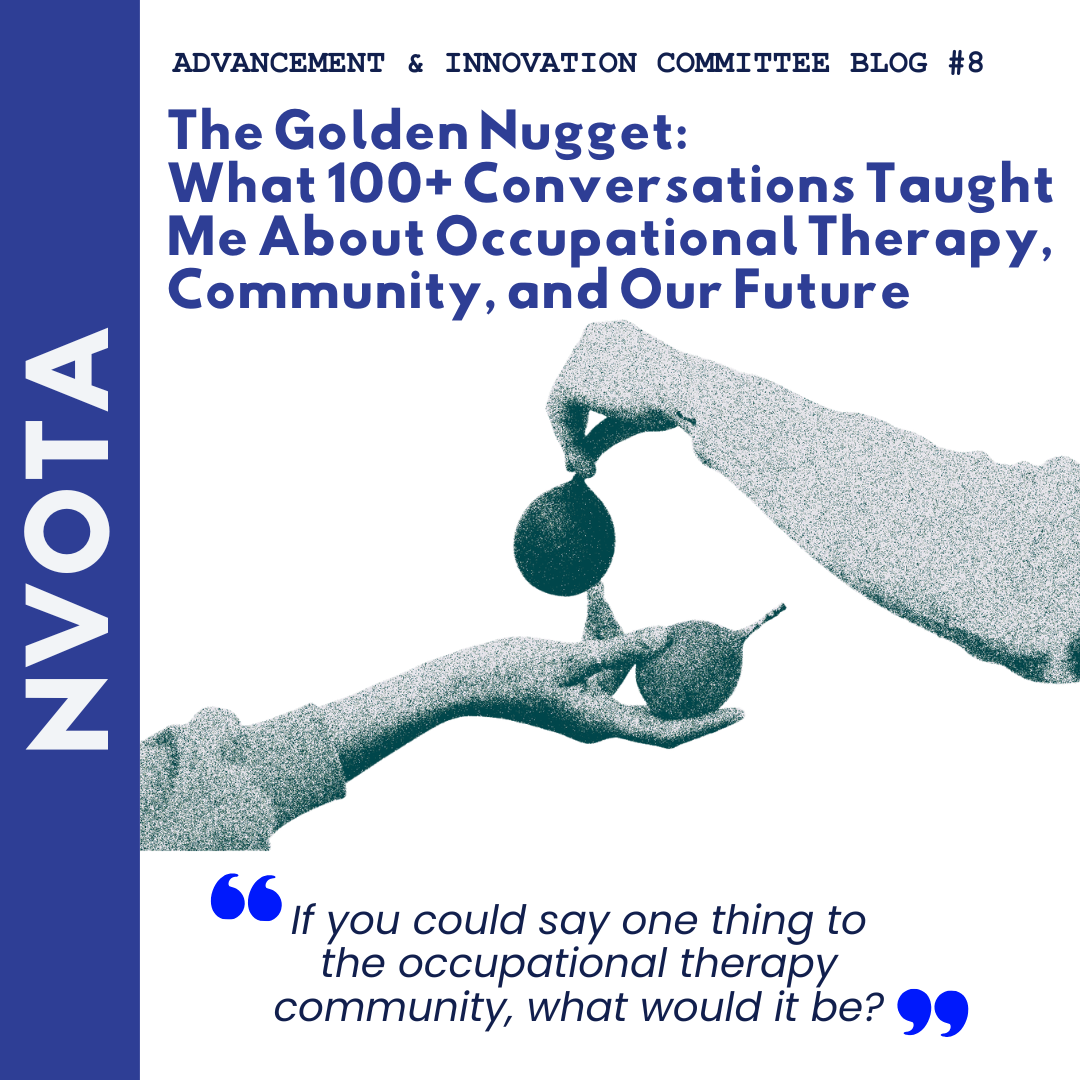
Blog: The Golden Nugget: What 100+ Conversations Taught Me About Occupational Therapy, Community, and Our Future
Matthew Brandenburg, OTD, OTR/L
For the past seven years, I’ve had the privilege of sitting behind a microphone in conversation with occupational therapy practitioners, researchers, educators, and leaders across the profession. What began as a project to translate evidence into practice evolved into a living archive of ideas, tensions, and possibilities shaping occupational therapy today.
Across more than 100 interviews, one pattern emerged that reshaped how I understand our profession and view my role within it.
At the end of each episode, I asked every guest the same question:
“If you could say one thing to the occupational therapy community, what would it be?”
We called it the golden nugget segment.
I expected a wide range of answers; clinical tips, research priorities, career advice. And those came. But overwhelmingly, the responses centered around community.
They reflected a call for occupational therapy to align around a clear identity and move forward with shared purpose. That insight reframed what I had learned from these conversations. Because while occupational therapy is filled with innovation, expertise, and impact, our greatest opportunity lies in how we align collectively.
A Profession Rich in Insight, But Still Defining Itself
The conversations featured on AOTA podcasts reflect a profession that understands something fundamental about health: Participation is THE outcome.
Across practice areas, from autism research to hospice care to mental health and population health, guests consistently emphasized that occupational therapy is about enabling people to participate in meaningful life roles.
We understand how routines shape behavior.
We understand how environments shape outcomes.
We understand how identity shapes motivation.
We are experts in purpose and participation.
And yet, a tension persists and is felt by students, expert practitioners, and everyone who knows what it’s like documenting through lunch, going the extra mile for our clients, and getting an insurance authorization denied. Occupational therapy knows what it is capable of, but struggles to consistently articulate, position, and advocate for that role within healthcare systems that reward reductionism, productivity, and reactive care.
We represent a profession with a strong evidence base, scope, and impact. But people still don’t know what we do! Could that be because our profession faces an alignment gap with the healthcare delivery systems we’re employed within?
The Golden Nugget: A Collective Call
The golden nugget responses revealed that even across different specialties, settings, and philosophies, practitioners are asking for the same thing:
“Lean into what makes OT unique.”, “Advocate for your role.”, “Think beyond the clinic.”, “Work together.”, “Stop underselling what we do.”
Each golden nugget segment presents an isolated reflection from innovative and inspired OTP who are actively engaged in doing the work that will propel our profession forward. When considered together, these responses are signals for our community.
Signals that our profession is ready to move from individual excellence to collective clarity. Because sometimes occupational therapy operates like a network of brilliant individuals solving problems in silos, rather than a unified force shaping systems.
What’s Holding Us Back?
The synthesis of these conversations highlighted familiar tensions:
- Participation vs. productivity. The daily tug-of-war between delivering meaningful, occupation-based care and racing against the clock to hit units, minutes, and documentation quotas that are designed to capture what matters most to systems and admin, not patients and families.
- Holistic care vs. reductionist systems. We’ve all had a moment where we’re addressing identity, habits, and life roles when the national rehab franchise we contract with politely asks to please just stick to shoulder flexion and toileting.
- Prevention vs. reimbursement. It hurts knowing exactly how to stop the fall, hospitalization, or decline before it happens, but getting paid only after it already did.
- Innovation vs. identity confusion. Expanding into exciting new spaces like primary care, mental health, and tech while everyone (including ourselves, sometimes) asks, “Wait… is this still OT?”
These are not new challenges. And they are not simple structural problems. They are collective problems that weigh heavily on the hearts and minds of our profession’s champions.
When a profession lacks a unified, clearly communicated identity, systems will define it for us. And too often, they already have.
Reclaiming Our Role: Purpose and Participation Experts
Across more than 100 AOTA podcast conversations, and in alignment with the foundational theories of occupational therapy, one idea emerges with striking consistency. We are experts in participation and purpose.
Not just function.
Not just independence.
Not just tasks.
Participation and purpose. In systems that prioritize efficiency, measurable outputs, and task performance, the question is often “Can this person do it?” Occupational therapy asks something more meaningful: “Does it matter to them? And can they live it every day?”
We uniquely understand and intervene on
- How habits are formed, broken, and rebuilt in real life.
- How environments enable or quietly restrict health and engagement
- How identity, meaning, and motivation determine whether health changes stick
- How families, caregivers, and communities shape outcomes long after medical and rehab interventions end.
No other profession integrates these elements the way occupational therapy does. And more importantly, we operationalize these insights.
We design morning routines for someone managing diabetes that actually fit their life.
We walk into a home, move the furniture, adjust the lighting, and reduce fall risk before the next hospitalization happens.
We coach care partners through real scenarios so they can confidently support participation day in and day out.
We help people figure out how to manage medications, navigate a grocery store, or return to a role that gives their life structure and meaning.
This is what purpose-driven, participation-based care looks like.
And it is exactly what the American healthcare system is missing.
We are living in a system overwhelmed by chronic disease, mental health challenges, caregiver burnout, and rising costs. We know that these problems are not solved by more information, more prescriptions, or more isolated interventions.
They are solved by changing how people live. By helping individuals build sustainable routines.
By designing environments that make healthy choices easier. By restoring roles, identity, and meaning in daily life. They are solved by occupational therapy.
No other profession is trained to integrate these elements into one coherent approach to care.
And yet, here’s the challenge:
We have not consistently owned this identity.
We describe ourselves in fragments as rehabilitation specialists, ADL experts, functional therapists and other labels that capture pieces of what we do, but not the full picture.
We undersell a profession that is uniquely positioned to lead in prevention, lifestyle redesign, and participation-based health.
And so we remain a profession that is essential, but too often under-recognized, underutilized, and brought in after the problem has already escalated.
The opportunity in front of us is to clearly define, and collectively stand behind, what we have been since our founding.
Experts in purpose.
Experts in participation.
Experts in how people actually live.
Community as the Mechanism for Change
This is where the golden nugget becomes more than a reflection. It becomes a roadmap.
If occupational therapy is going to fully realize its potential in healthcare, education, and community systems, it will require community-level alignment.
That means:
- Speaking a shared (evolving!) language about participation so that whether an OTP is in acute care, schools, primary care, or community health, we are reinforcing the same core message: participation and purpose are the outcomes that matter. Consistency builds recognition, and recognition builds influence.
- Advocating collectively for prevention and lifestyle-based care so that our voices are not scattered across settings, but amplified toward the same system-level goals: upstream intervention, caregiver support, and environments that promote health rather than react to decline.
- Elevating and supporting one another’s work so innovation doesn’t stay local. Too often, incredible programs exist in silos with one clinic, one system, or one passionate clinician. Community turns isolated success into scalable models by sharing, refining, and replicating what works.
- Creating structures that amplify our impact without diluting our scope. From professional organizations and collaborative networks to new care models and partnerships that allow occupational therapy to show up consistently and visibly in the spaces where decisions are made.
- Moving from “What do I do in my setting?” to “What do we stand for as a profession?” Because systems respond to unified value propositions more than they do to individual job descriptions.
Community is a strategy for how a profession moves from being present in a system, to being influential within it. Community is how we move from scattered advocacy efforts to coordinated change, individual expertise to collective authority, and under-recognition to undeniable impact. Without community, occupational therapy remains a collection of highly skilled practitioners navigating systems that don’t fully understand us. With community, we become a profession that defines its role, communicates its value clearly, and shapes the systems we practice within.
Community is more than conversation and connection. Community is coordination, amplification, and leverage. The OT community is where change happens.
We can Choose A Hopeful Future
Yes, tensions exist within our profession and practicing at the top of your license still sometimes feels like pushing against a rock. But heavy work is good for the nervous system and the conversations featured on AOTA podcasts left me with optimism.
Because the ideas are already here.
Listen to our interviews and a vision of the quintessential OT practitioner emerges as a participation scientist, a behavior change specialist, a routine architect, a systems thinker, a caregiver educator, a community health leader, a technology-enabled clinician. Living and breathing OTP are functioning in these roles already, just not always in a coordinated way.
Final Reflection: The Work Ahead
After seven years of listening, I’d like to add a message of my own:
Occupational therapy understands how people live. That is our greatest strength.
But understanding alone is not enough.
If we want a future where occupational therapy is fully integrated into prevention, population health, mental health, and community systems, we must do more than practice well.
We must align, define, and advocate together.
The golden nugget was never just advice.
It was a call.
A call to step out of silos and into shared purpose.
A call to name, own, and communicate our identity with clarity and confidence.
A call to align our voices so systems can no longer ignore them.
A call to create something together that no single practitioner, clinic, or setting could build alone.
A call to be a community.
Occupational therapy does not lack value. It lacks visibility, cohesion, and collective power. Those are things we can build. Together.